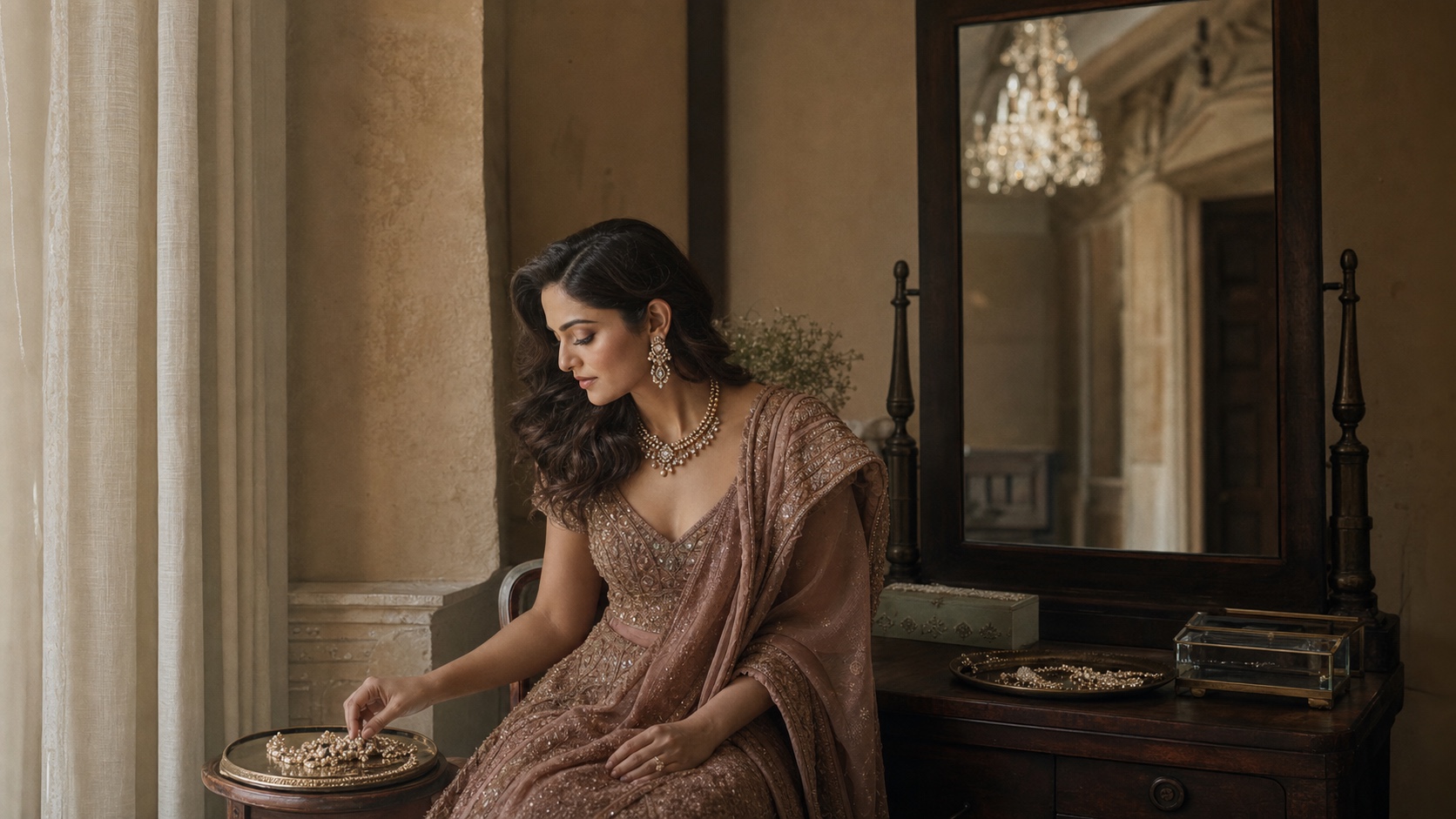
A reception has a different rhythm from a wedding ceremony.
The rituals are complete. The room feels more open. Guests arrive expecting conversation, photographs and an evening that may continue for several hours. The bride is no longer preparing for a sacred or traditional moment in quite the same way; she is entering a celebration.
Her makeup can respond to that shift.
Reception bridal makeup often allows for more polish, stronger definition or a change in mood. That does not mean the look must be heavier or more dramatic. It means the makeup can be considered in relation to the evening: artificial lighting, a different outfit, altered jewellery, formal portraits and the way the bride wants to feel once the ceremonies are behind her.
Some brides want a clear departure from their wedding look. Others feel most comfortable carrying the same softness into the reception with only a few deliberate changes.
Both approaches can feel complete.
The purpose of a reception makeup look is not to transform the bride into another person for the second half of the celebration. It is to create a look that belongs to the setting while preserving everything recognisable about her.
How Reception Makeup Differs From Ceremony Makeup
Ceremony makeup is often shaped by ritual, tradition and daylight.
The clothing may have cultural significance. Flowers, jewellery and ceremonial details create their own visual language. The makeup usually needs to remain composed through movement, emotion, heat and close contact with family.
A reception bridal look is often seen under very different conditions.
There may be stage lighting, chandeliers, direct photography flash or a darker ballroom. The bride may wear a gown instead of a saree, remove flowers from her hair or exchange traditional jewellery for a more contemporary arrangement.
These changes affect how the face is perceived.
Soft eye definition that looked beautifully balanced during a morning ceremony may recede beneath evening lighting. A lip colour chosen for red silk and temple jewellery may feel disconnected from an ivory gown. Skin that was kept controlled for outdoor heat may benefit from a more luminous finish indoors.
The difference should be considered rather than automatic.
Reception makeup does not need to mean a smoky eye, strong contour and dark lipstick. It may simply involve a slightly more defined lash line, additional cheek colour, a refined lip and a finish that responds well to evening light.
The question is not, “How can the reception look be more dramatic?”
It is, “What has changed, and what should the makeup do differently because of it?”
Begin With the Light
Lighting is one of the most important influences on Indian reception makeup.
Day receptions
A daytime reception may take place in a garden, under a covered terrace or inside a bright hotel ballroom. Natural light reveals texture and colour very clearly.
Makeup that is heavily powdered or intensely sculpted can appear more obvious in these conditions. A refined daytime look often benefits from thin complexion layers, softened transitions and colour that feels fresh rather than severe.
The eyes can still be defined, particularly when the bride is wearing formal clothing and jewellery. The definition simply needs to remain coherent at conversational distance.
Evening receptions
Evening lighting can soften colour and reduce facial dimension.
A reception held under warm chandeliers may make certain foundation or lip shades appear more golden. Cool LED lighting can flatten warmth in the complexion. Direct stage lighting can create shine through the centre of the face while leaving the outer features less visible.
This does not mean the makeup should be made universally darker.
Instead, structure can be added carefully: a clearer lash line, sufficient cheek colour, softly reinforced brows and a lip shade that remains present beneath the venue lighting.
Ask the photographer or planner about the lighting if the venue is unfamiliar. Photographs of the actual reception room are often more useful than the venue’s promotional images.
Consider the Complete Change, Not Just the Makeup
A successful reception bridal look begins with everything that will be different from the ceremony.
The outfit may change in colour, shape and scale. Jewellery may become more minimal or more formal. Hair may be released from a bun, reshaped into waves or arranged into a cleaner evening style.
The makeup should be planned as part of this complete transition.
A bride moving from a traditional Kanjeevaram saree into a structured gown may want a quieter relationship between the eyes and lips. A bride changing from ivory wedding clothing into a jewel-toned lehenga may need more colour so that the face does not disappear beside the fabric.
It is also important to decide whether the reception look is a full removal and reapplication or a carefully managed transformation of the ceremony makeup.
A complete new look requires time for cleansing, skin preparation, hair changes, dressing and photography. A shorter transition may involve refreshing the complexion, adjusting the eyes, changing the lip and rebuilding only the areas that have worn.
Neither process should be rushed into an unrealistic interval.
Reception Makeup With a Saree
A saree creates long, elegant lines and often places significant visual detail close to the face.
The makeup should consider the fabric, border, blouse and drape rather than responding only to colour.
A silk saree with traditional jewellery may suit softly defined eyes, clear cheek colour and a lip with enough warmth to remain connected to the textile. The finish can be polished without becoming overly reflective.
For a contemporary metallic, tissue or organza saree, the makeup may feel lighter and more tonal. Taupe, muted rose, antique gold and soft brown can create definition without repeating the shine of the fabric.
When the saree is heavily embellished, the face does not always need equal intensity. One area can lead.
A softly smoky eye may be balanced with a restrained lip. A richer lip can allow the eye makeup to remain clean and elongated. Giving every feature the same visual weight can make the overall reception bridal look feel crowded.
The drape also influences body makeup and visible skin. Neck, shoulders, back and arms should feel balanced with the complexion, but they do not need to be covered heavily. Any body product should remain comfortable and avoid transferring onto the saree.
Reception Makeup With a Lehenga
A reception lehenga often carries considerable visual scale.
Embroidery, structured silhouettes and layered jewellery can create a formal presence that needs enough facial definition to remain balanced in photographs.
The colour story matters.
Deep emerald, navy, wine or aubergine may support softly smoked eyes, muted metallics and a lip that has clear depth. Pastel lehengas often work beautifully with tonal rose, peach, mauve or softly defined brown eyes.
The makeup does not need to match the outfit literally.
Repeating a strong fabric colour directly on the eyelids can make the look feel overly coordinated. It is often more refined to respond to the undertone of the clothing, the metal in the embroidery or one quieter shade within the textile.
For example, an emerald lehenga does not necessarily require green eye makeup. Bronze, antique gold, warm brown or a muted olive accent may connect more naturally.
The jewellery should remain part of the decision. A large necklace and detailed earrings already bring considerable attention toward the face. The makeup can provide clarity and structure without adding another competing element.
Reception Makeup With a Gown
A gown often changes the proportions of the complete bridal look.
The neckline may be more open. Jewellery may become smaller. Hair may move more freely. The overall effect can feel formal and contemporary rather than ceremonial.
This often creates room for makeup with cleaner lines.
A softly extended eye, a sculpted but diffused cheek or a defined lip can feel elegant with a gown. The complexion should still look like skin; excessive contour can appear disconnected from the fluidity of the clothing.
Ivory, champagne or silver gowns require careful colour balance. A complexion made too pale can disappear into the outfit, while an overly warm base may look separate under flash photography.
Rose, mauve, neutral berry and softened red can bring life to light-coloured gowns. For darker gowns, the lip can remain understated if the eyes carry sufficient definition.
If the neckline reveals the shoulders and chest, the transition from face to body becomes particularly important. Skin tone should feel coherent without making the visible body look uniformly coated.
Reception Makeup With Indo-Western Outfits
Indo-western clothing allows several visual languages to exist together.
There may be a tailored silhouette with traditional embroidery, a draped skirt with a structured blouse or a contemporary outfit worn with inherited jewellery.
The makeup should not force the look entirely toward “Indian” or “Western.”
Instead, it can reflect the balance already present in the clothing.
A clean complexion and softly architectural eye may suit a sharply tailored outfit. A draped silhouette may feel more complete with blended colour, luminous skin and gentle movement through the hair.
Indo-western reception makeup is often most successful when it avoids obvious categories. The look does not need to prove its modernity with severe contour or graphic eyeliner.
Modern bridal beauty can be quiet.
It may be expressed through precise skin work, thoughtful colour and the confidence to leave some features less defined.
Eye Makeup for the Reception
Reception eye makeup should be designed around the bride’s eye shape, comfort and venue lighting.
A smoky eye can be soft and dimensional rather than dark. Brown, taupe, bronze, muted plum and charcoal can create depth without turning the eye into a single block of colour.
The placement matters more than the name of the look.
Some eyes benefit from definition concentrated at the lash line. Others suit colour lifted gently toward the outer corner. Deepening the entire socket does not automatically make the eyes look larger or more formal.
Metallic finishes should be used with restraint. A fine satin sheen can catch evening light beautifully. Large reflective particles may become distracting under direct flash or draw attention to texture on the eyelid.
Eyeliner can be softly blended, cleanly extended or kept very close to the lashes. The choice should respond to the eye rather than follow a fixed reception formula.
False lashes are also not compulsory. Individual clusters, a half lash or carefully built mascara may create enough definition. Comfort matters, especially after a long day of ceremonies.
The bride should still be able to see, speak and move without feeling that her eyes have become heavy.
Choosing a Lip Colour
Lip colour often changes the entire feeling of reception bridal makeup.
A soft rose or muted peach can feel polished with luminous skin. Mauve and neutral berry shades bring quiet depth to evening looks. A classic red can be striking when the rest of the face is kept balanced.
The right shade should be considered in relation to skin tone, outfit, lighting and the bride’s familiarity with colour.
A lipstick that appears subtle in daylight may look much quieter under warm reception lighting. A nude shade chosen without enough undertone can make the face appear flat in photographs.
“Nude” should not mean colourless.
A natural reception lip usually needs enough rose, brown, peach or berry to remain present beside formal clothing.
Texture also matters. A very dry matte lip may last but become uncomfortable through conversation and dinner. A high-gloss finish may move easily or reflect strongly under flash.
A softly defined satin or comfortable matte often offers a useful balance. The lip can be refreshed without rebuilding the entire makeup look.
Creating the Right Skin Finish
Reception skin should look considered in person before it is judged through a camera.
The finish may be luminous, satin or softly matte depending on the bride’s skin and the environment. No single finish is universally more elegant.
Luminous skin is not created by making the entire face reflective. Light can be preserved on the upper cheek and other natural high points while the centre of the face remains controlled.
A satin finish often photographs beautifully because it retains dimension without creating obvious shine. For oily skin, selective preparation and setting can support longevity while allowing the cheeks to remain alive.
Coverage should be built only where it contributes.
Pigmentation and redness can be corrected without creating the same density across every part of the face. Texture remains real skin, even under carefully applied makeup.
Reception makeup may need to last through stage photographs, greetings, dinner and dancing. Longevity comes from appropriate preparation and measured layers, not simply from using more foundation or powder.
Hairstyles for a Reception Bridal Look
The reception hairstyle should consider the outfit, jewellery, face and practical length of the evening.
Soft waves can create movement with a gown or contemporary lehenga. A structured bun may suit a saree, high neckline or statement jewellery. A sleek ponytail can feel refined with an Indo-western outfit when the proportions support it.
The ceremony hairstyle does not always need to be completely dismantled.
Flowers may be removed, the front reshaped and the bun refined with a different accessory. Alternatively, a bride may want a clear change from a traditional ceremony arrangement into softer evening hair.
Time should guide the decision.
Releasing an elaborate bun into smooth waves is not always a quick change. The hair may carry product, pins and texture created for the first style. A completely different reception hairstyle needs enough time to be rebuilt properly.
Jewellery and neckline should be available when the final style is selected. Large earrings can become hidden within loose hair, while a detailed blouse back may be better appreciated with the hair lifted.
Coordinating Jewellery and Makeup
Jewellery changes how colour and definition appear around the face.
Temple jewellery often introduces warm gold and strong traditional detail. Diamonds and cool-toned stones reflect light differently. Emeralds, rubies and coloured stones may create a distinct focal point.
The makeup can acknowledge these elements without matching them literally.
Gold jewellery may suit warm brown, bronze, terracotta or softened rose, but it can also look elegant with cooler contrast when the bride’s colouring supports it.
Diamond jewellery can work with taupe, mauve, charcoal and clean neutral tones. When coloured stones are prominent, repeating the exact colour on the eyes is rarely necessary.
Scale is as important as colour.
Large earrings, layered necklaces and a detailed headpiece already frame the face. Strong eyes, cheeks and lips added at equal intensity may leave no place for the viewer’s attention to rest.
Luxury reception makeup often feels composed because it understands what to leave quiet.
Reception Makeup Trends in India
Reception makeup trends in India have moved away from one fixed idea of glamour.
Many brides are choosing visible skin, softly diffused eye definition and lip colours that feel familiar. Others are returning to richer lips, polished buns and references drawn from classic Indian portraiture.
Muted monochromatic looks remain relevant, particularly rose, peach, bronze and mauve. These colours can connect the eyes, cheeks and lips without making the face appear overly matched.
Softly smoked liner has also become more common than heavy black shadow. It provides evening definition while preserving the natural shape of the eye.
Another shift is the growing interest in personalised contrast.
A bride in a minimal gown may choose a deeper lip. A heavily embroidered lehenga may be paired with quiet skin and softly defined eyes. Modern reception makeup ideas are becoming less dependent on the assumption that formal clothing always requires heavier makeup.
Trends can provide language and references.
They should not decide the face.
A timeless reception look is usually one that still makes sense once the trend name has been forgotten.
Common Reception Makeup Mistakes
One common mistake is planning the makeup without the reception lighting.
A look designed only in front of a bright mirror may lose definition on a stage or appear too reflective under direct lights.
Another is treating the reception as an opportunity to include every dramatic element at once. Smoky eyes, strong contour, shimmer, heavy lashes and a deep lip can compete with each other.
Changing the bride’s personality too sharply can also make the look feel uncomfortable. A woman who rarely wears strong eye makeup may not suddenly feel at ease with an intense smoky eye simply because it is her reception.
Rushing the transition creates practical problems. Removing ceremony makeup, preparing the skin again, changing hair, dressing and taking photographs all require real time.
Using excessive powder in the hope of improving longevity can make the complexion look flat or textured. Long wear should be planned through preparation, product compatibility and restrained layering.
The final mistake is continuing to adjust the look because several people offer different opinions.
Reception rooms can become busy. The bride and artist should have a clear direction before that noise begins.
Professional Tips for a Calm Reception Change
Plan the reception look alongside the ceremony look rather than treating it as a separate decision made later.
Confirm whether the makeup will be transformed or completely reapplied. Share the final outfit, jewellery and hairstyle references. Discuss the lighting and how long the reception is expected to continue.
If there is a short changeover, organise clothing and accessories in advance. Assign one person to manage calls, transport and family questions.
Eat, drink water and take a few quiet minutes before beginning the reception preparation. A bride moving directly from one ceremony into another chair may need a pause more than she needs another visual decision.
Keep touch-ups simple. Lip colour, blotting papers and a small amount of powder may be enough. Repeatedly layering foundation rarely improves a complexion that has begun to move.
Most importantly, say what feels unfamiliar.
A reception makeup look can be more defined than the wedding look while still feeling like the same woman.
Frequently Asked Questions
What is reception bridal makeup?
Reception bridal makeup is a look designed for the celebration following the wedding ceremony. It often responds to evening lighting, a new outfit, changed jewellery, formal photography and a longer social event. It may be more defined than ceremony makeup, but it does not need to be heavier.
How should reception makeup differ from wedding makeup?
The difference should reflect what changes between the ceremony and reception. Evening lighting may require clearer definition, while a gown or contemporary lehenga may support a different colour story. Some brides choose a complete change; others refine the existing wedding makeup.
Which makeup look is suitable for an evening reception?
An evening reception makeup look usually benefits from balanced skin, defined eyes or lips and enough cheek colour to remain visible under artificial lighting. The exact intensity should suit the bride’s features, outfit, jewellery and comfort rather than following one standard formula.
Should reception makeup be darker than wedding makeup?
Not necessarily. Evening lighting may require stronger contrast, but that can come from precise lash definition, a richer lip or clearer cheek colour. Making every part of the face darker can overwhelm the bride and compete with formal clothing.
Which lip colour works for an Indian reception makeup look?
Muted rose, mauve, berry, terracotta, peach-brown and classic red can all work beautifully. The choice depends on skin tone, outfit colour, jewellery and eye makeup. The lip should contain enough colour to remain visible under reception lighting.
Is smoky eye makeup suitable for a reception?
Yes, when the placement suits the bride’s eye shape and personal style. A smoky eye does not need to be black or very dark. Brown, taupe, bronze, plum and charcoal can create softer depth while remaining refined.
Can natural makeup work for a reception?
Yes. Natural reception bridal makeup can include polished skin, softly defined eyes, balanced brows and a lip colour that remains present in photographs. Natural does not mean invisible; it means the bride remains immediately recognisable.
What skin finish is appropriate for reception makeup?
Satin, luminous and softly matte finishes can all work. The choice should reflect the bride’s skin and venue conditions. A satin finish often provides dimension without excessive shine, while strategic setting can support oily skin through a long evening.
How long does reception bridal makeup take?
Timing depends on whether the ceremony makeup is being transformed or removed completely. Hair, draping and jewellery changes also affect the schedule. A full reapplication needs a realistic preparation window rather than being treated as a brief touch-up.
Should I change my hairstyle for the reception?
Only if the new hairstyle supports the outfit and the schedule allows it. A clear change can create a different reception mood, but an existing style can also be refined by removing flowers, changing accessories or adjusting the front.
How should makeup be coordinated with reception jewellery?
Consider the metal, stones and scale of the jewellery. Makeup can respond to its warmth or contrast without matching colours literally. When the jewellery is large or detailed, leaving one part of the makeup quieter often creates a more composed result.
Do I need a bridal makeup trial for my reception look?
A trial can be useful when the reception look differs significantly from the bride’s usual makeup, involves a strong eye or lip, or must be transformed quickly from the ceremony look. It helps clarify comfort, colour and the practical changeover plan.
How can reception makeup last through photographs and dancing?
Longevity begins with suitable skin preparation and thin, compatible product layers. Strategic setting, a comfortable lip formula and simple touch-ups help the makeup wear gracefully. Applying more foundation or powder does not automatically make it last longer.
What should I carry for reception makeup touch-ups?
A lip colour, blotting papers, tissues and a small amount of the agreed powder are usually sufficient. Brides wearing contact lenses may also want eye drops recommended by their doctor. The touch-up kit should remain simple and easy to use.
Conclusion
A reception look should feel like a continuation of the wedding story, even when the clothing, hair and mood have changed.
It may be softer than expected or more defined than the ceremony makeup. It may centre on luminous skin, a smoked eye, a considered lip or simply the quiet confidence of a bride who still recognises herself.
The most enduring reception makeup ideas are rarely the ones that attempt to include everything.
They respond to the woman, the light and the way the evening will be lived.
When those things are considered together, the makeup does not need to announce that it is timeless.
It simply continues to feel right.