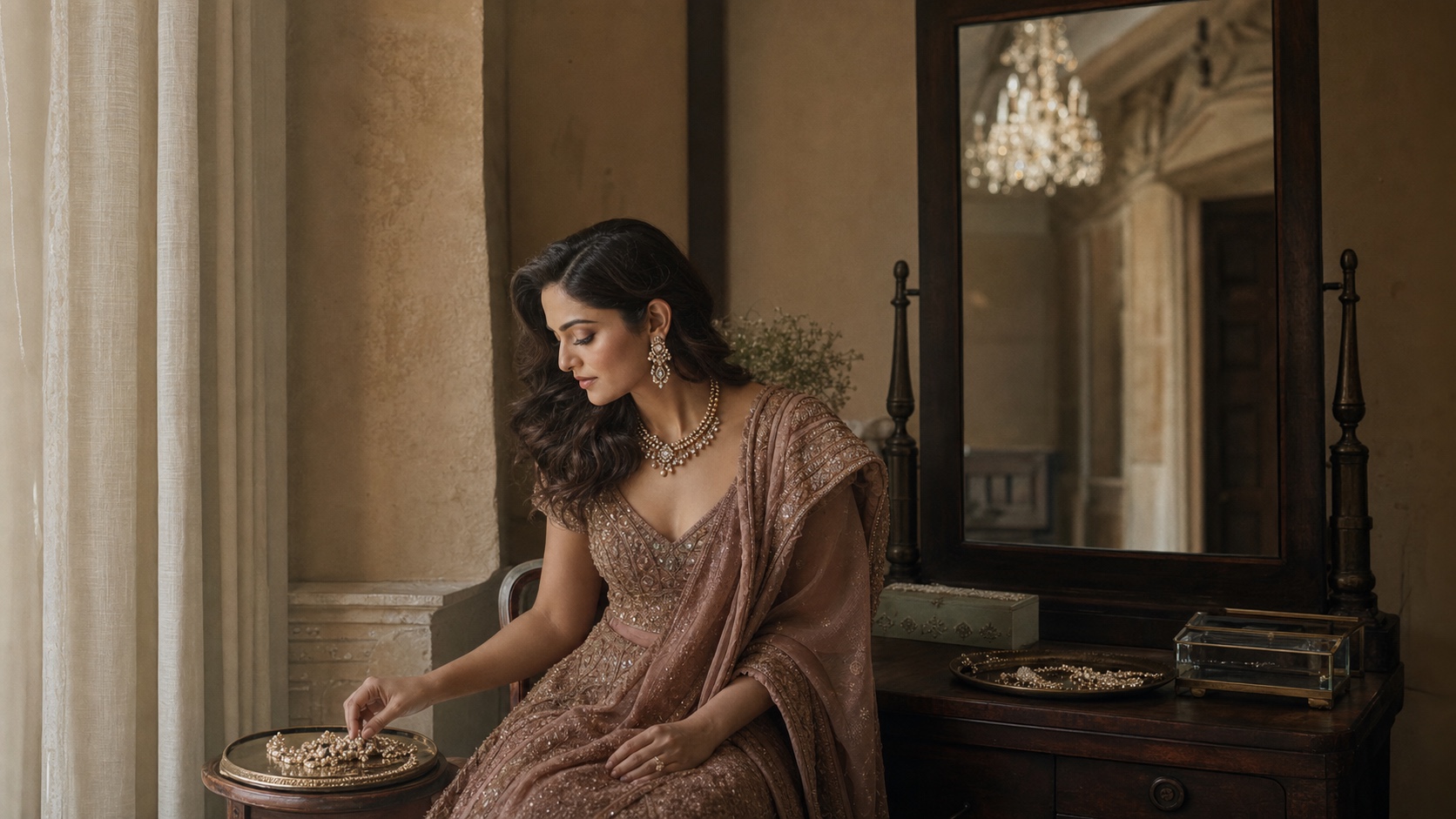
There are brides who begin with a colour story. There are others who begin with an image of a blouse, a room, a flower or a favourite lipstick. And then there are the pieces that arrive with their own history: a grandmother’s necklace, earrings worn at a mother’s wedding, a bangle that has lived in a family locker for decades.
Heirloom jewellery changes the brief. It is not an accessory added at the end of a look. It has a point of view already. Its gold may be deeper than a new set; its stones may be irregular; its scale may be generous; its meaning may be private. The most convincing bridal makeup does not try to outshine any of that. It notices what the piece is asking for, then gives the face enough clarity to stand comfortably beside it.
This is not a rule about making the makeup quieter. Some heirloom sets call for a clear red mouth, a defined eye or a blush with real presence. The point is proportion. When jewellery, fabric and makeup are each making a different argument, the finished image feels busy. When they share a rhythm, the bride looks like herself in a more ceremonial register.
That rhythm is often more useful than a mood board full of finished faces. It lets a look be personal without becoming over-designed. It also gives an artist practical information: where the eye should land, what must show up in photographs and what can remain simply beautiful at close range.
Begin With What Is Being Kept
Before discussing eyeshadow or lip colour, make a small inventory of the things that cannot—or should not—change. A family necklace. A nath. A particular saree worn for the main ceremony. The red of a Banarasi border. A temple-jewellery set selected with a parent. These are not constraints in the dull sense. They are the beginning of the edit.
A useful first conversation is less about trend language and more about atmosphere. Does the jewellery feel intricate and devotional, sculptural and old-world, light and floral, regal and symmetrical? Does the bride want the face to feel polished, soft, graphic, warm, pared back? The answer does not have to be technical. “I want it to feel like my grandmother’s gold, but not costume-like” is a remarkably clear direction.
Photographs help, but the right photographs help more. Send one close-up that shows the metal and stone colours, one image that shows the scale near the face, and one image of the jewellery with the outfit if that is possible. A smartphone image in daylight is entirely sufficient. An artist does not need a catalogue. She needs to understand the temperature of the gold, the size of the earring, the direction of the pendant and whether the pieces will create strong visual movement near the cheek and jaw.
The same logic applies to fabric. A saree is never just “red” or “ivory.” It may read cool, tomato, brick, rose, wine, rust, coral, gold-flecked or almost brown depending on the weave and the light. Hold it beside the jewellery if you can. The relationship between the two will often reveal whether the makeup needs an equal warmth, a controlled contrast or a little neutrality.
This is why a bridal makeup trial is most valuable when it is treated as a planning session rather than a quick preview. The goal is not to recreate a photograph from the internet. It is to see how the bride’s own features hold the details that matter to her.
Read the Jewellery Before Choosing the Colour
Jewellery carries colour in more ways than we usually acknowledge. Yellow gold brings warmth even when the stones are clear. Antique gold often has a softened, almost matte depth. Polki can catch the light in a way that feels delicate but insistent. Emerald, ruby, pearl, coral and enamel all move the eye in different directions.
Notice the metal first
Very bright yellow gold can make cool, pale foundation shades look disconnected. Antique gold and champagne-toned pieces tend to sit beautifully beside a complexion that has retained warmth and dimension. Silver, white gold and diamond-heavy jewellery may support a softer taupe, rose, plum or neutral-brown story, particularly if the outfit is cool in tone.
None of this means the face must be bronzed to match the necklace. Foundation should still look like skin. What changes is the surrounding colour: the warmth in the cheek, the brown used through the crease, the undertone of a nude lip. Subtle decisions are usually enough.
Then look at scale and placement
A broad choker, shoulder-skimming jhumkas and a maang tikka all create detail in the same field as the eyes and mouth. When there is that much beauty near the face, it helps to decide which makeup feature is leading. Strong jewellery can make a precisely lined eye feel refined; it can also make a heavy lid, very thick lashes and a dark lip feel like too many arrivals at once.
Conversely, a fine pendant and smaller earrings can make room for more colour through the mouth or a little more definition at the eye. The finished result should not be timid. It should have somewhere to breathe.
Let stones suggest, not dictate
Matching emerald stones with green eyeshadow is rarely the only answer, and often not the most lasting one. A tiny suggestion can be more elegant: a bronzed eye with a muted olive at the lash line, or a rose-brown mouth beside emerald jewellery. Rubies may bring out a warmer berry lip; pearls can make a satin finish feel especially considered. The connection can be felt rather than announced.
Think of the stone colour as a note in a composition, not a command. A look becomes more modern when it nods to the jewellery instead of illustrating it.
“The most memorable bridal looks do not match every element. They make every element feel expected.”
Silk Is Not a Backdrop
Indian bridal silk has its own kind of light. Kanjeevaram, Banarasi, tissue, raw silk and brocade absorb and reflect colour differently. The same lip shade can seem romantic beside a dusty rose weave and severe next to a high-shine red border. An outfit has movement, texture and density. Makeup needs to meet it with enough intention that the face remains part of the image.
Start with the visual weight of the fabric. A dense, embellished saree or lehenga already contains contrast: metallic thread, border work, embroidery, perhaps a heavy blouse. In these cases, skin often benefits from a finish that has shape but not excess sheen. The high points of the face can remain alive; the centre can be lightly controlled; the eye and lip can be chosen with more restraint.
A pared-back silk, meanwhile, may need a little more presence from the face. This does not require a dramatic look. It may mean a deeper lip outline, a fuller brow, a slightly more visible cheek or a refined lash line. The aim is to make the bride legible in the portrait without asking the fabric to do all the work.
Be especially cautious with the word nude. A pale nude lip beside saturated bridal silk can make the face recede. A good bridal nude usually contains enough rose, brown, terracotta or berry to read as colour. It is neutral only in relation to the rest of the look, not absent.
For red, the undertone matters more than the drama. Vermilion, crimson, chilli red, oxblood and berry all sit differently beside gold. If the saree is a warm red with antique gold, a rose-brown or softened warm red may make more sense than a cool purple berry. If the red is deep and blue-based, a mouth with cooler structure can look beautifully intentional. Testing under the actual ceremony lighting is more reliable than testing under a bathroom bulb.
For ivory, gold and pastel silk, it is easy to overcorrect towards invisibility. These textiles can tolerate colour. A muted rose cheek, a softly defined eye, a lip that has depth and a skin finish with gentle dimension give pale fabric something to sit beside. The bride should not disappear into the palette simply because it is quiet.
Choose One Leading Note
A complete bridal look usually has one feature that carries the visual sentence. It might be the eyes, the mouth, the jewellery or the silk itself. Everything else supports that feature.
With a statement choker and formal jhumkas, the eyes might lead through shape rather than colour: a clean elongated liner, lashes that frame but do not obscure, brows with soft definition. The lips can then be warm and present without asking for equal attention. With a more minimal pearl set, a berry mouth may become the point of focus while the eyes stay luminous and considered.
This is not a prescription for taking something away. It is a way to avoid uniform intensity. Strong eyes, strong contour, very bright highlight, large lashes, saturated cheeks and a dark lip can each be lovely in isolation. Together, next to a heavily worked bridal outfit, they can make the face feel less like a face and more like a collection of effects.
Ask a simple question in the trial: where should a person look first when they meet you? There is no wrong answer. Some brides want the warmth of a lip, others the expression in their eyes, others the beauty of an heirloom necklace. Once that answer is clear, the other choices become easier.
A leading note also makes photographs more coherent. Wedding images move between close portraits, family pictures, ceremony frames and wide views of the outfit. A look with hierarchy will hold together in all of them. It will have detail at close range without becoming noisy from afar.
Plan the Trial as an Edit, Not a Performance
The trial is the right place to test proportion. Bring the references, yes, but also bring an honest account of what you usually enjoy seeing on your own face. A bride who never wears a defined lip may still choose one for her wedding; she simply deserves enough time to decide whether it feels celebratory or unfamiliar. A bride who loves a kohl-rimmed eye may find that the softness comes from the complexion and cheek rather than from removing the definition she recognises.
Start with the base. A bridal complexion should look credible before jewellery is added. If the finish only works with a filter or under one kind of light, it will not become more convincing next to an heirloom choker. The skin needs a lived-in quality: even where it needs to be even, luminous where it can be luminous, and secure enough to last without looking fixed in place.
Then test colour in full context. Hold up the blouse, drape the saree, place the jewellery near the face. Take a few photographs in daylight and in the indoor light that most resembles the venue. The question is not whether every image is flattering in isolation. It is whether the complete look has a shared temperature.
Be careful not to make decisions from a single close-up. A lip can look strong in a phone selfie and exactly right in a full bridal portrait. A gentle eye can look understated at the mirror and be beautifully balanced once the jewellery and hair are in place. Ask for both distances.
It helps to leave the trial with a short, written description rather than a long list of products: softly structured skin; warm rose cheek; elongated brown liner; antique gold on the lid; rose-brown lip; no sharp contour; keep the jewellery as the brightest detail. That is a plan an artist can execute calmly on the wedding morning.
For brides navigating several functions, build a sequence rather than a set of unrelated faces. The main wedding look can hold the heaviest jewellery and most ceremonial fabric. The mehendi may carry a warmer, lighter version of the same colour story. The reception can change direction if the clothing and light genuinely change. A reception makeup plan works best when it acknowledges that entire arc.
On the Wedding Morning, Bring the Pieces Into the Room
It is surprisingly easy for jewellery to become a last-minute reveal. The boxes arrive with a relative, the final necklace is brought out after hair is complete, and everyone is then deciding whether the lip should be changed with very little time left. This does not need to be dramatic, but it does need a place in the timeline.
Ask for the final near-the-face pieces to be in the preparation room before makeup is completed. The artist does not need to put everything on early. She simply needs to see the necklace, earrings, maang tikka and any nath or hair ornaments that will alter the visual balance. Five quiet minutes of looking can prevent a hurried change later.
Hair and jewellery deserve the same consideration. If the hair is very sleek, intricate temple jewellery may read more graphic and formal. If flowers soften the back of a bun, the face can hold a little more glow. If the earrings have real movement, test them with the head turn the bride will make during photographs. Comfort is part of the finish; a bride continually adjusting an earring will not feel composed no matter how beautiful the colour story is.
Protect the face from avoidable disruption. Drape, jewellery and hair are often finalised after makeup, so give them enough time. Keep one person responsible for the boxes and another for the immediate getting-ready area. A calm wedding-morning timeline makes space for these details without treating them as an interruption.
The best moment often comes just before the bride leaves the room. The jewellery is in place. The silk has settled. The makeup has become part of the whole rather than an item to inspect separately. That is when the look stops being a plan and becomes a person, dressed for an important day in a way that could belong to no one else.
Frequently Asked Questions
Should bridal makeup match jewellery exactly?
No. Exact matching can make a look feel literal. Makeup should acknowledge the jewellery’s warmth, formality and scale, then create its own quieter structure. A related undertone is usually more elegant than an identical colour.
What should I share with my makeup artist before the trial?
Send a close-up of the jewellery, a full view of the outfit or fabric, any hair ornament that will sit near the face and a few pictures of looks you feel most like yourself in. Context is more valuable than twenty near-identical inspiration images.
Can bold heirloom jewellery work with a natural bridal look?
Absolutely. Natural bridal makeup is not invisible makeup. It can include defined eyes, a real lip colour and careful skin work. The distinction is that the choices remain believable on the bride rather than becoming a collection of separate trends.
How do I plan makeup around a red saree and gold jewellery?
Look at the undertone of the red, the depth of the gold and the ceremony light. Then test a few lip and cheek directions beside the actual fabric. The most useful answer will come from the complete composition, not from a universal rule about red lipstick.
Do I need the final jewellery before makeup planning begins?
Not always. The plan can begin from photographs, metal tones and a sense of scale. But final near-the-face pieces should be available at the trial and in the preparation room so the finishing choices can be made with confidence.